

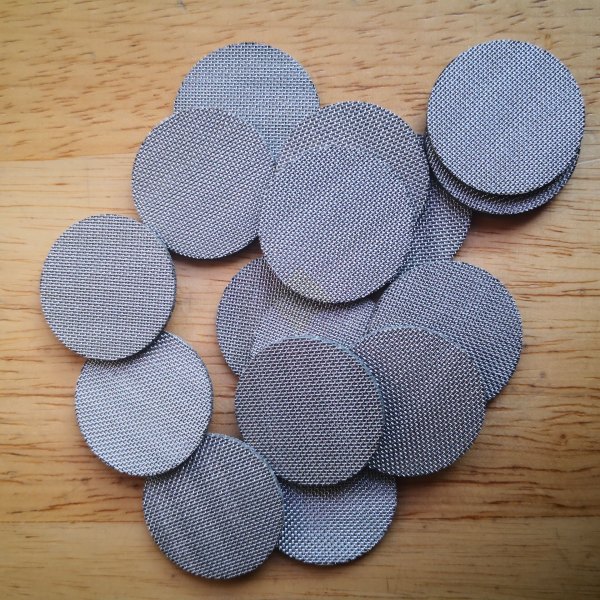
We produce high-quality woven wire cloth made of stainless steel wire, available in plain Dutch weave and twill Dutch weave structures, specially designed for molten material filtration applications.
This mesh structure follows a similar pattern to standard plain weave. However, its warp wires feature a larger diameter than weft wires. The closely packed weft wires form tapered wedge-shaped openings instead of conventional square apertures. In plain Dutch weave, warp wires remain straight, while all the crimping deformation is concentrated on the weft wires.
This wire cloth adopts a twill-based weaving structure, with thicker warp wires and finer weft wires. Densely arranged weft wires create compact tapered wedge-shaped filtration openings. Warp wires stay straight throughout the weaving process, and all crimping stress is absorbed by the weft wires. Thanks to the unique twill construction, weft wires undergo dual-direction deformation: both vertical crimping around warp wires and lateral bending deformation.
| Warp/Shute Mesh | Gauge | Wire Diameter (mm) | Nominal Micron Retention |
|---|---|---|---|
| 12/64 | 26 × 26 | 0.457 × 0.457 | 180 |
| 24/110 | 28 × 32 | 0.376 × 0.274 | 115 |
| 30/250 | 38 × 42 | 0.132 × 0.102 | 70 |
| 50/250 | 38.5 × 41 | 0.140 × 0.112 | 60 |
| 50/600 | 40 × 44 | 0.122 × 0.081 | 30 |
| 80/400 | 40 × 45.5 | 0.102 × 0.063 | 40 |
| 80/700 | 42 × 44 | 0.102 × 0.063 | 35 |
| 100/600 | 42 × 45.5 | 0.102 × 0.081 | 25 |
| 120/600 | 42 × 45.5 | 0.102 × 0.063 | 28 |
| 170/1400 | 43.5 × 48 | 0.063 × 0.040 | 10 |
| 200/600 | 47 × 48 | 0.50 × 0.040 | 20 |
| 325/2300 | 48 × 40 | 0.40 × 0.122 | 5 |
Woven wire cloth is mainly adopted in absorption, evaporation and filtration in petroleum, chemical, medical, metallurgy, machinery, shipbuilding and automobile industries. It is used to remove mist droplets and liquid foam. It can also be applied as air filter material for cars and trucks, and processed into extruder screens for melt filtration.
